
Your record should be open — and a two-way street
Read every note before you leave — and reply right in your record.
For most of medical history, the notes a clinician wrote about you were written about you, not with you — and kept from you. The OpenNotes movement changed that, and U.S. law now backs it: under the 21st Century Cures Act’s information-blocking rules, you have the right to read the clinical notes in your own record, electronically and without delay.
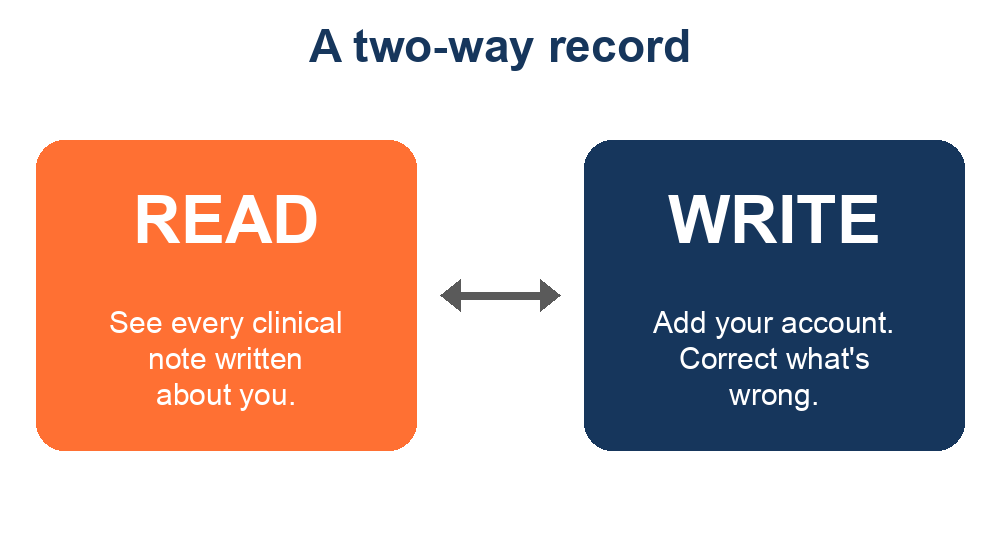
Patient Rights Now believes that’s only half the story. Your record should be bidirectional — you should be able to add your account and propose corrections easily, without friction, for your care team to review and reflect in the record.
What Fair Notes requires
- Review before you leave. Every note from your encounter, available for you to read before you leave the clinic — and ideally before the visit even ends — not days later, if at all.
- Respond in one step. A simple, built-in way to request a correction, or add an insight your provider missed, the moment you spot it — no generating a fresh PDF, no faxed form, no bureaucratic amendment process built to wear you down.
- Reply right inside the record. If there’s a patient portal, you should be able to respond directly to the note within the EMR — not be frustrated by software deliberately built to shut out fast, helpful feedback from patients.
Why fair notes matter
- Accuracy. Errors in your chart follow you from visit to visit. When you can read and respond, mistakes get caught.
- Trust. Notes written knowing you’ll read them are clearer, kinder, and more honest.
- Memory. Most people forget much of what’s said in a visit. Your notes are the record you get to keep.
- Voice. Your side of the story deserves a place in your own record.
Where the law stands today
The Cures Act Final Rule (in effect since 2021) makes it unlawful for providers and health-IT vendors to block your access to your electronic health information, including clinical notes — “open notes.” You can typically read them through your patient portal at no cost.
What the law does not yet guarantee is the rest of Fair Notes: your notes in hand before you leave, and a one-step way to correct them. Today, access can lag days behind the visit, and “amendment” often means a clunky paper or PDF process built to discourage you. That’s the gap we organize to close.
What we’re fighting for
- Open notes by default — every patient, every visit, no fees, no friction.
- A one-step right to propose corrections — flag an error or add your account directly in your record for your care team to review and act on, not via a faxed form or fresh PDF.
- Notes in your hands before you leave the visit — not days later.
- Plain-language records you can actually understand.
- No retaliation for patients who read, question, or correct their notes.
Learn more & allies
We stand with the broader open-records movement. Start here:
- OpenNotes — the international movement to make clinical notes open to patients.
- ONC 21st Century Cures Act Final Rule — the federal rule that gives you access to your notes.
- HHS: Your right to access your medical records — HIPAA right-of-access basics.
Wear the movement
One wristband. Four fair rights. Start the conversation.
Get your wristband Share your story